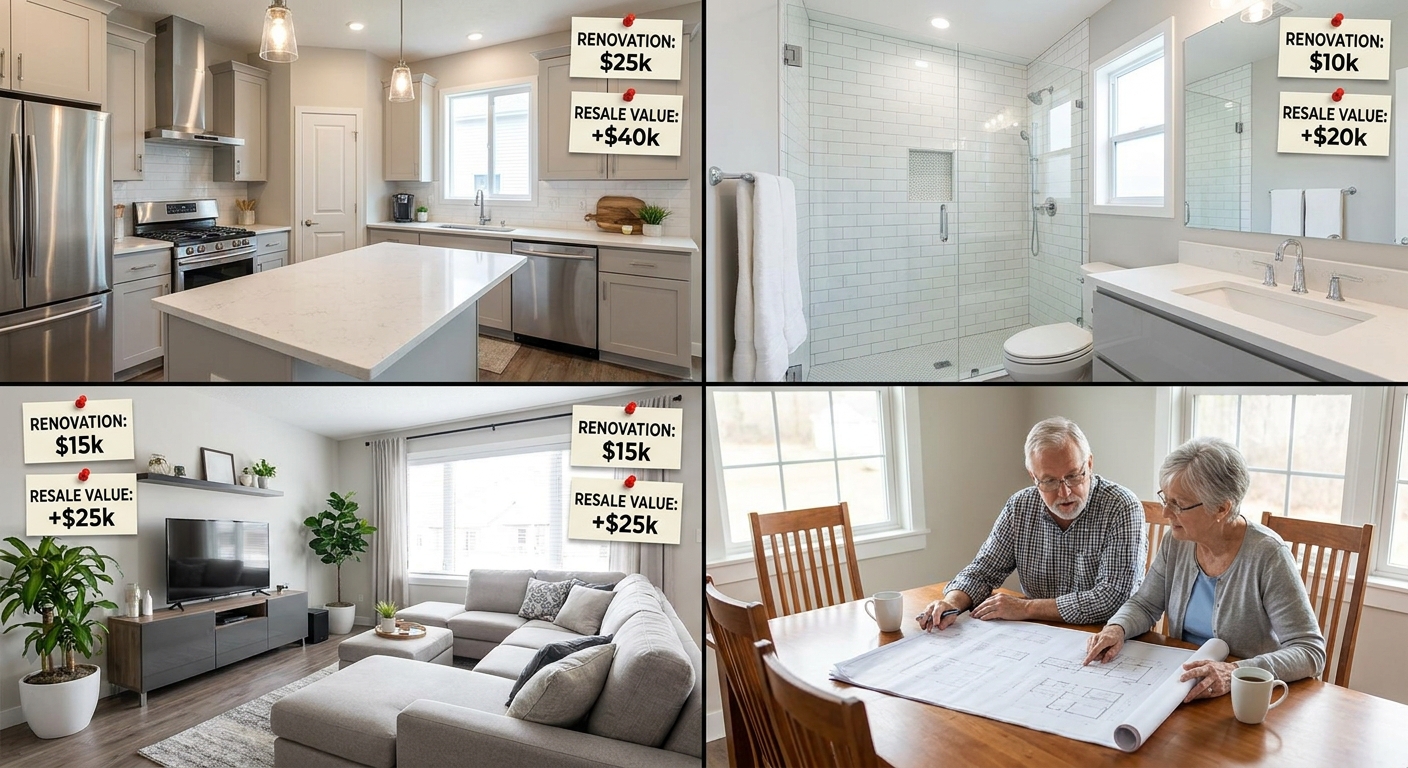
Renovation plans often start with inspiration photos and a rough budget in mind. But the real question for both first-time and repeat homeowners is simpler and more demanding:
Introduction
Will this renovation actually add value beyond what it costs?
This guide walks through how to evaluate renovation value step by step, using clear numbers, realistic examples, and a framework you can reuse for any project.
Key Terms You Need to Know
Before looking at numbers, understand the basic concepts used by appraisers, lenders and buyers:
- After-Repair Value (ARV): The estimated market value of your home after the renovation is completed.
- Current Market Value: What your home would sell for right now, in its present condition.
- Renovation Cost: All-in cost of the project: labor, materials, permits, design fees, contingency, and temporary housing if needed.
- Equity: The portion of your home you own outright.
- Formula:
Equity = Home Value – Mortgage Balance - Return on Investment (ROI): The percentage of renovation cost you are likely to recover in increased value.
- Simple formula:
ROI = (Value Added ÷ Renovation Cost) × 100
Step 1: Estimate Your Home’s Current and Future Value
A. Current Market Value
Use at least two of these:
Online valuation tools (rough starting point)
2. Recent comparable sales ("comps") within 0.5–1 mile, similar size and condition
Agent or appraiser opinion (more accurate, costs more)
Example
You own a 3-bed, 2-bath home.
- Recent similar sales: $435,000 – $455,000
- An agent suggests listing at: $445,000
You set your current value at $445,000.
B. After-Repair Value (ARV)
Look at comps that match the home after renovation, not current condition.
Suppose after a planned kitchen and bath remodel, comps show:
- Similar renovated homes: $495,000 – $515,000
- A local agent expects yours could fetch: $505,000
You estimate ARV at $505,000.
Step 2: Calculate the Real Cost of the Renovation
Don’t just use the contractor’s base quote. Include:
- Contractor labor and materials
- Design or architect fees
- Permits and inspections
- Appliance upgrades
- Contingency (usually 10–20%)
- Possible temporary housing / storage
Sample Project: Mid-range kitchen + guest bathroom update
| Cost Item | Amount |
|---|---|
| Contractor quote (labor+materials) | $42,000 |
| Appliances & fixtures | $6,000 |
| Permits and inspections | $1,200 |
| Design consultation | $800 |
| Contingency (15%) | $7,500 |
| Total estimated cost | $57,500 |
Round up to $58,000 to stay conservative.
Step 3: Work Out the Value Added and ROI
From our earlier numbers:
- Current value: $445,000
- ARV (after renovation): $505,000
- Value increase: $505,000 – $445,000 = $60,000
- Renovation cost: $58,000
Now calculate ROI:
ROI = (Value Added ÷ Renovation Cost) × 100
ROI = ($60,000 ÷ $58,000) × 100 ≈ 103%
This suggests you recover slightly more than you spend, on paper.
However, this is before financing costs and selling costs (if you plan to sell soon).
Step 4: Factor in Financing – Cash vs Loan
Option 1: Pay Cash
- You pay $58,000 from savings.
- No monthly payments or interest.
- Equity increases by roughly the value added.
Using our example:
- Equity before:
- Mortgage balance: $320,000
- Home value: $445,000
- Equity: $125,000
- Equity after:
- New value: $505,000
- Mortgage balance unchanged: $320,000
- Equity: $185,000
You’ve traded $58,000 cash for $60,000 more equity, a slight net gain and improved home quality.
Option 2: Use a Renovation/Equity Loan
Assume:
- Loan amount: $58,000
- Interest rate: 7.0% fixed
- Term: 15 years
- Estimated closing costs: 2.5% of loan ($1,450)
Monthly payment estimate (rounded):
- A 15-year loan at 7.0% ≈ $8.99 per $1,000 borrowed
- $58,000 × 8.99 / 1000 ≈ $521/month
Total of payments over 15 years:
- $521 × 180 months = $93,780
Total cost of financing (interest + closing):
- Total payments + closing – principal = $93,780 + $1,450 – $58,000 ≈ $37,230 in financing cost.
Now your true total cost of the renovation is:
- $58,000 (work) + $37,230 (financing) ≈ $95,230
You added $60,000 in value but spent $95,230 all-in. In purely financial terms, that’s a negative cash ROI if you carry the loan to the end.
However, if you:
- Plan to stay long term,
- Value living quality and functionality, and
- Plan to prepay the loan faster,
then the non-financial benefits may justify the project.
Step 5: Compare Renovation Scenarios Side by Side
Scenario A: Basic surface refresh
- Paint, minor repairs, lighting, hardware updates.
| Item | Amount |
|---|---|
| Cost | $15,000 |
| ARV increase estimate | +$20,000 |
| Value added | $20,000 |
| ROI (no financing) | (20k/15k) ≈ 133% |
| Likely impact on sale speed | High (more buyers) |
Scenario B: Full structural kitchen remake
- Moving walls, high-end finishes, custom cabinets.
| Item | Amount |
|---|---|
| Cost | $90,000 |
| ARV increase estimate | +$55,000 |
| Value added | $55,000 |
| ROI (no financing) | (55k/90k) ≈ 61% |
Takeaway
- Smaller, well-targeted improvements often give higher ROI.
- Large luxury upgrades can be worth it for personal enjoyment, but they rarely return 100% of cost in value.
Checklist: How to Evaluate Any Renovation’s Value
Use this list before you sign a contract:
Define your goal clearly
- [ ] Increase resale value soon - [ ] Improve long-term comfort - [ ] Address safety/structural issues
Estimate current home value
- [ ] Gather 3–5 comparable recent sales - [ ] Request a pricing opinion from an agent or appraiser
Estimate After-Repair Value (ARV)
- [ ] Find renovated comps that match your planned finish level - [ ] Adjust for size, location, and condition differences
Get at least two detailed quotes
- [ ] Labor, materials, permits clearly itemized - [ ] Confirm who handles design, demo, and cleanup
Include full project costs
- [ ] 10–20% contingency - [ ] Appliances, fixtures, and finishes - [ ] Temporary housing or storage if needed
Run the numbers
- [ ] Calculate: Value Added = ARV – Current Value - [ ] Calculate ROI = Value Added ÷ Total Cost - [ ] Factor in interest and closing costs if using financing
Stress-test your assumptions
- [ ] What if ARV is 5–10% lower than expected? - [ ] Can you comfortably afford the payment if rates rise (for variable loans)?
Common Mistakes When Assessing Renovation Value
Over-improving for the neighborhood
Adding a luxury kitchen in a modest area often caps your value below what you spent.
Ignoring financing cost
Looking only at contractor quotes and forgetting interest, loan fees, and taxes.
Using best-case ARV only
Sensible planning uses a conservative ARV and still works.
Under-budgeting contingency
Hidden issues in older homes are common; 5% contingency is rarely enough.
Chasing trends
Highly specific or trendy finishes may hurt resale in a few years.
When a Renovation Makes Sense Even With Weak ROI
Renovations are not purely financial decisions. Consider going ahead even if ROI is modest when:
- You plan to stay 7–10+ years and value daily enjoyment.
- The work addresses safety, moisture, or structural problems.
- Energy upgrades reduce long-term bills and improve comfort.
In those cases, think of the project as part investment, part lifestyle spending, and be honest about each component.
Final Framework You Can Reuse
For any project, repeat this simple 5-step approach:
- Estimate current value using real comps.
- Estimate ARV based on post-renovation comps.
- Add all costs, including contingency and financing.
- Calculate value added and ROI, using conservative assumptions.
- Decide based on both money and lifestyle, not just one.
This calm, numbers-first process won’t eliminate every surprise, but it will help you avoid the most expensive mistakes and decide which renovations truly add value to your home and your life.