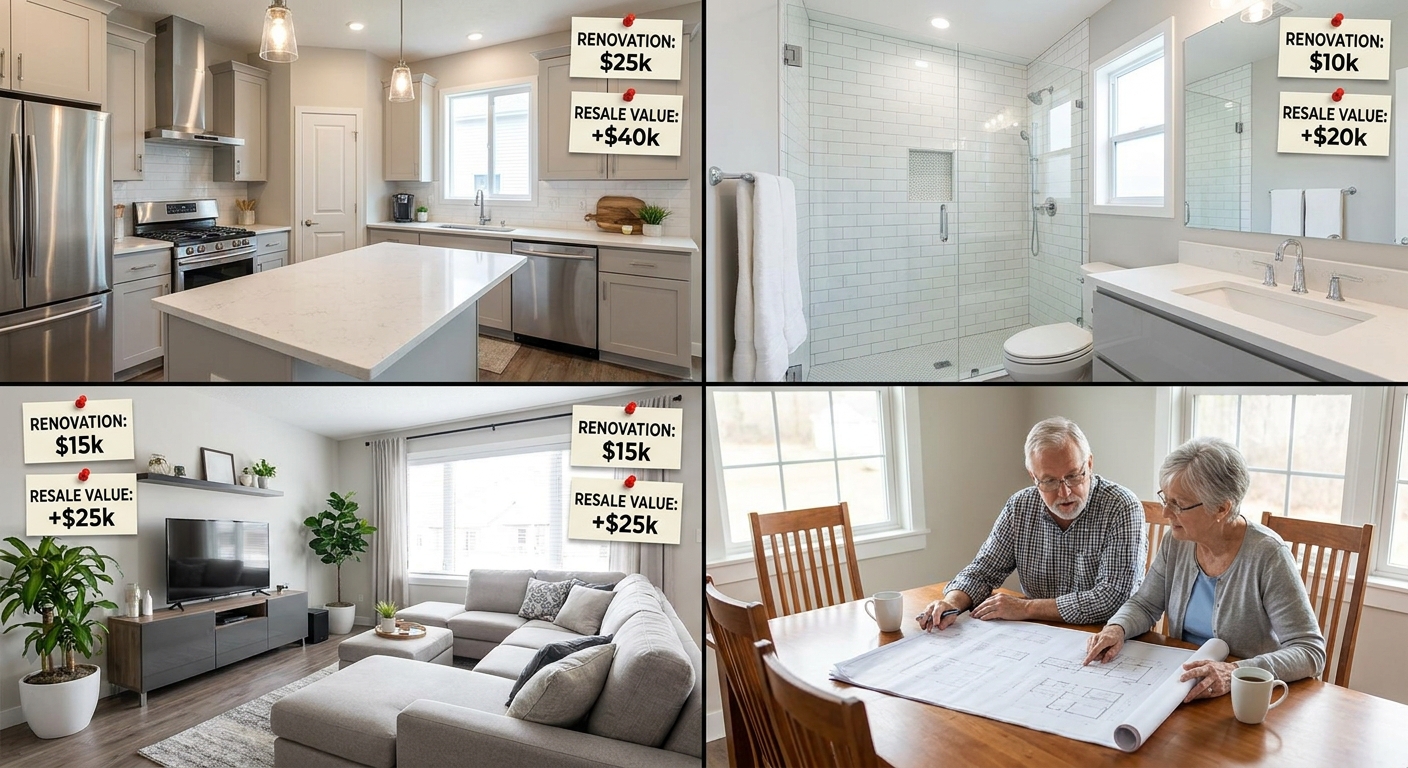
Two identical renovations can have very different financial outcomes depending on how they are financed. For first-time and repeat homeowners, understanding loan structures, costs, and trade-offs is central to protecting long-term equity.
Why Financing Method Matters for Renovation Value
This guide explains common renovation financing options, uses worked examples with realistic rates, and shows how different choices change your monthly payment and total cost.
Key Financing Terms Explained
- Principal: The amount of money you borrow.
- Interest Rate: The annual cost of borrowing, expressed as a percentage.
- Term: How long you have to pay the loan back (e.g., 15 or 30 years).
- Closing Costs: One-time fees paid at loan signing: appraisal, origination, title, recording, etc., typically 2–5% of the loan amount.
- LTV (Loan-to-Value): Loan amount divided by the property’s value. Lenders often cap LTV for renovation financing (e.g., 80–90%).
- Draw Schedule: For construction-type loans, funds are released in stages as work progresses.
The Home: Baseline Example
Assume this starting point:
- Current home value: $400,000
- Current mortgage balance: $260,000
- Current interest rate: 4.0%, 27 years remaining
- Monthly principal and interest: ≈ $1,238 (rounded)
- Planned renovation budget: $70,000
- Expected ARV: $460,000
You want to finance all $70,000 and compare methods.
Option 1: Cash-Out Refinance
You replace your current mortgage with a larger one, and take the difference in cash.
Step 1: Determine Max Loan Amount
Suppose your lender allows 80% LTV based on ARV.
- ARV: $460,000
- Max 80% LTV loan: $460,000 × 0.80 = $368,000
You currently owe $260,000, so the maximum cash you could potentially access:
- $368,000 – $260,000 = $108,000 (theoretical upper limit)
You only need $70,000 for renovations.
Step 2: Sample Refinance Terms
Assume current market rate for a 30-year cash-out refinance is 6.25%.
- New loan: $330,000 (260k to pay off old loan + 70k cash to you)
- Term: 30 years
- Interest rate: 6.25%
- Closing costs: 3% of loan = $9,900 (often rolled into the loan; we’ll include them in the balance)
New total loan: $339,900 (if costs are financed).
Monthly payment estimate (principal + interest):
- At 6.25%, 30 years ≈ $6.16 per $1,000 borrowed
- $339,900 × 6.16 / 1000 ≈ $2,094/month
Step 3: Compare Before vs After
| Item | Before Refi | After Cash‑Out Refi |
|---|---|---|
| Loan balance | $260,000 | $339,900 |
| Interest rate | 4.00% | 6.25% |
| Monthly P&I | ~$1,238 | ~$2,094 |
| Cash available for reno | $0 | $70,000 |
| Closing costs (one-time) | — | ~$9,900 |
Impact: You obtain renovation funds, but your monthly payment rises by ≈ $856 and you restart a 30-year clock at a higher rate.
Equity after renovation (assuming project adds full $60,000 value increase to $460,000):
- New value: $460,000
- Loan: $339,900
- Equity: $120,100 (down from $140,000 pre-refi, but your home is upgraded).
Option 2: Home Equity Loan (Fixed Rate)
You keep your existing mortgage and add a second loan.
Sample Terms
- Home value (current, not ARV): $400,000
- 80% LTV limit on combined loans: 0.80 × 400,000 = $320,000
- Existing mortgage: $260,000
- Maximum equity loan: $320,000 – $260,000 = $60,000
But your renovation budget is $70,000, so you either:
- Reduce scope to $60,000, or
- Contribute $10,000 cash, or
- Seek a product allowing higher LTV.
Assume you proceed with a $60,000 home equity loan.
- Loan amount: $60,000
- Interest rate: 8.0% fixed
- Term: 15 years
- Closing costs: 2% = $1,200 (paid up front from savings)
Monthly payment estimate:
- At 8.0%, 15 years ≈ $9.56 per $1,000
- $60,000 × 9.56 / 1000 ≈ $574/month
Combined Monthly Housing Payment
| Component | Amount |
|---|---|
| Existing mortgage P&I | ~$1,238 |
| New home equity loan P&I | ~$574 |
| Total P&I | ~$1,812 |
Increase in monthly payment vs original: $574.
Equity After Renovation (Assume $60k work adds $50k value)
- New value: $450,000
- Combined loans: $260,000 + $60,000 = $320,000
- Equity: $130,000 (slightly lower than original $140,000, but with a better home).
Option 3: Renovation Mortgage (Purchase + Reno or Refi + Reno)
Some lenders offer a combined product where your loan is based on ARV. These are often used when purchasing a fixer, but also for major upgrades.
Assume a refinance-style renovation mortgage on the same property.
Sample Terms
- ARV: $460,000
- Max LTV: 90% of ARV = $414,000
- Renovation costs approved: $70,000 (held in escrow, released by draws)
Your new loan might be structured as:
- Loan: $330,000 (similar to cash-out example, but with specialized oversight)
- Rate: 6.0%
- Term: 30 years
- Closing: 3.5% = ~$11,550
If closing costs are financed:
- Total initial loan: ~$341,550
Monthly payment estimate:
- At 6.0%, 30 years ≈ $6.00 per $1,000
- $341,550 × 6.00 / 1000 ≈ $2,049/month
This is similar in outcome to the cash-out refi, but the renovation mortgage may:
- Allow higher LTV,
- Include inspections and draw oversight,
- Require more documentation and time.
Side-by-Side Comparison of Financing Choices
Using the earlier figures, loosely standardized to a $70,000 project:
| Feature | Cash‑Out Refi | Home Equity Loan (60k) | Renovation Mortgage |
|---|---|---|---|
| Keeps low 4% mortgage? | No (replaced) | Yes | No (replaced) |
| Approx. new P&I total | ~$2,094 | ~$1,812 | ~$2,049 |
| Access to full 70k? | Yes | No (60k cap in example) | Yes (via ARV) |
| Closing costs (approx) | ~$9,900 | ~$1,200 | ~$11,550 |
| Complexity of process | Moderate | Low–Moderate | High |
| Oversight of contractor | Limited | Limited | Structured draw system |
Interpretation:
- If keeping your low-rate first mortgage is a priority, a home equity loan preserves it but may limit your project size.
- If you need maximum funds and are comfortable with a full refinance, a cash-out refi or renovation mortgage could work, but at the cost of a higher main rate.
Checklist: Choosing a Renovation Financing Path
Clarify your priorities
- [ ] Lowest possible total cost over life of loan - [ ] Lowest monthly payment today - [ ] Keep existing low-rate mortgage - [ ] Access maximum funds for major project
Gather key numbers
- [ ] Current home value and loan balance - [ ] Estimated ARV (with comps) - [ ] Detailed contractor bid with timeline
Model three scenarios
- [ ] Cash-out refinance - [ ] Home equity loan / HELOC - [ ] Renovation mortgage (if available)
Compare on these dimensions
- [ ] New total monthly payment - [ ] Total interest and fees over expected holding period (e.g., 7–10 years) - [ ] Impact on equity after renovation - [ ] Flexibility to prepay
Stress-test your budget
- [ ] Can you still meet savings and emergency goals with the new payment? - [ ] Is your job/income stable enough to support short-term cost overruns?
Common Mistakes When Financing Renovation Value
Focusing only on monthly payment
Longer-term or interest-only options may look cheap now but cost far more overall.
Ignoring closing costs and fees
A slightly higher rate with lower fees can sometimes be cheaper than a low-rate, high-fee loan.
Refinancing a great low-rate loan too quickly
If you already have a very low mortgage rate, swapping it for a higher one just to access funds can erode long-term value.
Over-borrowing based on ARV optimism
If the renovation doesn’t fully deliver expected value, you could end up over-leveraged.
Not checking prepayment flexibility
Some loans penalize early repayment; others allow you to reduce interest cost substantially if you pay down faster.
How to Decide What Fits You
Ask yourself:
- How long do I reasonably expect to stay in this home?
- Is preserving my existing low mortgage rate worth reducing project size?
- Can I realistically pay extra each month to shorten the new loan term?
Then compare options based on your realistic holding period (e.g., 8 years, not 30). Looking only at lifetime interest can be misleading if you’re unlikely to keep the loan that long.
Closing Thoughts
Renovation value is not just about construction quality and design—it is also about how you finance the work. By:
Understanding key loan types,
Running concrete numbers on payment, cost, and equity, and
Stress-testing your assumptions,
you can choose a financing structure that supports both a better home and a more resilient financial position.