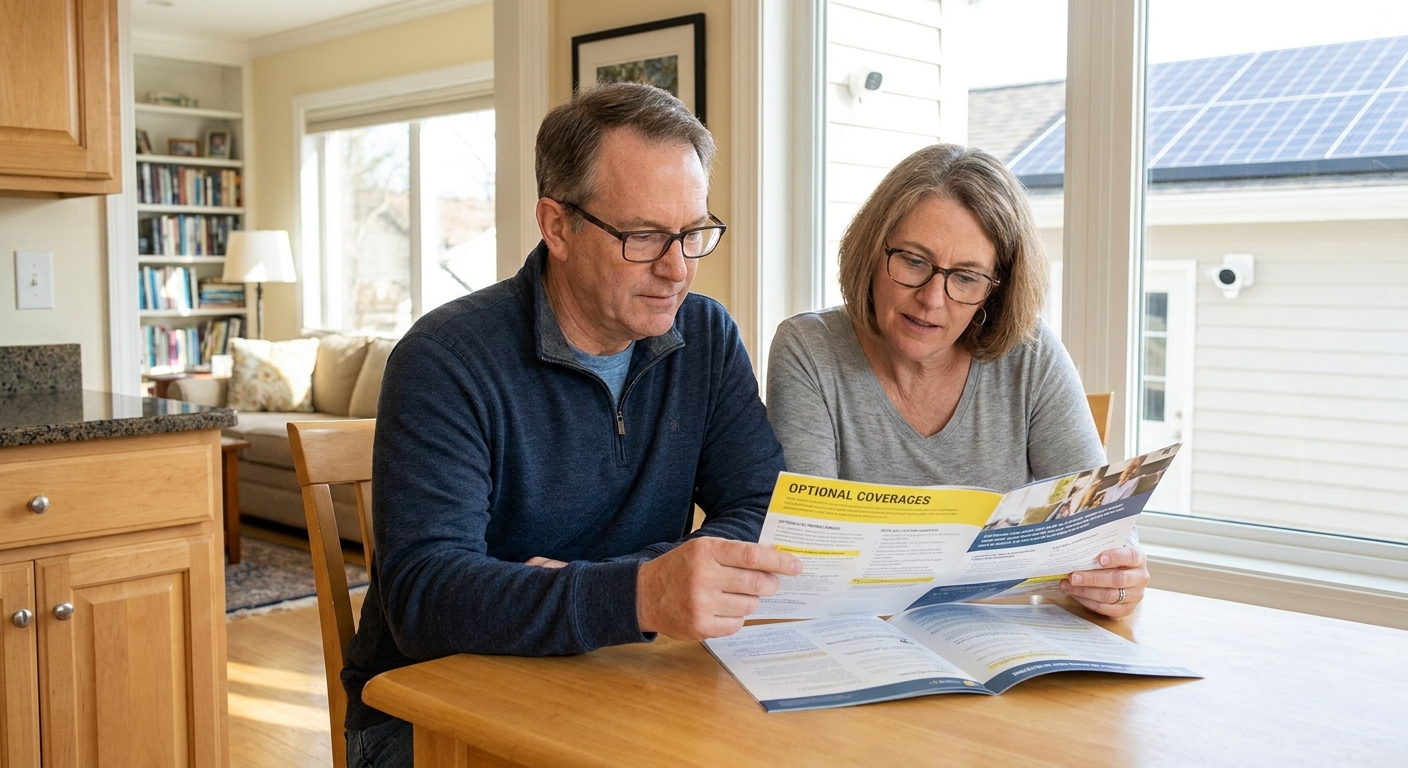
Standard home insurance policies cover many common risks, but they leave important gaps. Optional coverages—also called endorsements or riders—can fill these gaps at modest cost.
Why Optional Coverages Matter
This article explains major optional coverages, what they typically cost, and simple scenarios showing when they can save you substantial money.
1. Water Backup and Sump Overflow
What It Covers
Water backup endorsements usually cover damage when water backs up through:
- Drains or sewers, or
- Sump pumps or related equipment
Standard policies often exclude this type of water damage.
Typical Limits and Costs
Common coverage limits: $5,000–$25,000 or more, depending on insurer.
Typical added premium: roughly $40–$200/year, depending on limit and risk.
Example Scenario
- Finished basement with flooring, drywall, and furniture.
- Sump pump fails during a storm, leading to 4 inches of water.
- Total damage: $18,000 (tear-out + dry-out + repairs + contents).
- Claim likely denied; you pay the full $18,000.
- Covered amount: $18,000 − $1,000 = $17,000 paid by insurer.
Without the endorsement:
With a $20,000 water backup endorsement and a $1,000 deductible:
Over 10 years, if the endorsement costs $120/year, you’ve paid $1,200 in extra premium—versus a one-time $17,000 benefit.
2. Scheduled Personal Property (Valuables)
What It Covers
Most policies have low sub-limits for valuables like:
- Jewelry
- Watches
- Fine art
- Firearms
- Collectibles
A typical unscheduled limit might be $1,500–$2,500 per loss for jewelry.
Scheduling items means listing them individually, often with appraisals, to insure them for higher, specific amounts.
Typical Costs
Premiums vary by item type and value, but as a rough guide:
- $10,000 diamond ring might cost $80–$140/year to schedule.
- Many insurers offer broader coverage (more perils, sometimes no deductible) on scheduled items.
Example Scenario
- You own $25,000 of jewelry; policy sub-limit is $2,500 per loss.
- A theft occurs; most jewelry is taken.
- You receive up to the sub-limit: $2,500.
- You could receive the full $25,000, subject to documentation.
Without scheduling:
With scheduling to $25,000 total and a $0 deductible:
3. Ordinance or Law Coverage
What It Covers
After a covered loss, local building codes may require you to:
- Upgrade electrical systems,
- Add sprinklers or safety features, or
- Rebuild portions of your home that weren’t directly damaged, so the home meets current code.
Standard policies often include a small amount (10% of dwelling) by default.
Example and Costs
- Dwelling limit: $300,000
- Default ordinance/law: 10% = $30,000
- Optional upgrade: 25% or 50% of dwelling for an added $20–$70/year.
Scenario:
- Severe fire damages 60% of your 40-year-old home.
- Authorities require the entire structure to be rebuilt to current code.
- Additional code-related costs: $50,000.
- $30,000 available, leaving you $20,000 short.
- The full $50,000 extra can be covered (subject to policy terms).
With only 10% ($30,000):
With 25% ($75,000):
4. Extended or Guaranteed Replacement Cost on the Dwelling
What It Does
Construction costs often rise after major disasters due to demand surges. Extended replacement cost raises your effective dwelling limit above the printed amount—often by 10–25% or more.
Some insurers offer guaranteed replacement cost, covering full rebuild cost regardless of limit, subject to conditions.
Typical Cost
- Often 5–15% added to the base premium for that dwelling coverage.
Example
- Dwelling limit: $350,000
- Extended replacement: 25% (up to $437,500)
- Added premium: $180/year.
Large regional catastrophe:
- Rebuild cost for your home ends up at $405,000 due to post-disaster inflation.
- Payout may cap at $350,000 (minus deductible).
- $405,000 is within the $437,500 ceiling; you are better protected.
Without extended replacement:
With 25% extended:
Over 10 years, total extra premium ~$1,800 for up to ~$87,500 of potential additional coverage.
5. Equipment Breakdown Coverage
What It Covers
This endorsement often covers sudden mechanical or electrical breakdowns of:
- HVAC systems
- Appliances
- Boilers
- Home systems such as electrical panels, sometimes including smart home equipment
Wear and tear is still excluded, but sudden breakdowns (e.g., short circuits) may be covered.
Typical Cost
- Often $30–$60/year with deductibles around $500.
Example Scenario
- Central air conditioning compressor fails suddenly in summer.
- Replacement cost: $4,000.
- May be considered mechanical failure; not covered.
- Payout: $4,000 − $500 = $3,500.
Without equipment breakdown:
With endorsement and $500 deductible:
6. Service Line Coverage
What It Covers
Underground service lines from the street to your home, such as:
- Water pipes
- Sewer lines
- Some electrical or communication lines
Damage to these lines is typically your responsibility, not the utility’s.
Typical Cost and Limits
- Limits: Often $10,000–$20,000 per occurrence.
- Cost: Roughly $30–$80/year.
Example Scenario
- Your sewer line collapses under the yard due to age and shifting soil.
- Total repair cost: $8,000 (excavation + repair + landscaping).
- You pay the full $8,000.
- Payout: $8,000 − $500 = $7,500.
Without coverage:
With service line coverage and $500 deductible:
7. Flood and Earthquake Coverage (Often Separate Policies)
Flood Insurance
Standard home insurance generally does not cover flood from rising water, storm surge, or overflowing rivers.
Flood insurance may be:
- Purchased through a national program or private insurers.
- Required by lenders in certain high-risk zones.
Costs vary widely; examples:
- Low-risk area: $400–$700/year for basic coverage.
- Higher-risk zones: premiums can be substantially higher.
Earthquake Insurance
Also typically excluded from standard policies.
- Sold as a separate policy or endorsement.
- Premiums depend on proximity to fault lines, building type, and soil condition.
If you live in a seismically active region, quantify the risk and at least price a policy.
Checklist: Which Optional Coverages to Consider?
Use this list as a starting point, then discuss specifics with a licensed professional.
- [ ] Finished or partially finished basement → water backup/sump overflow.
- [ ] Jewelry, art, or collectibles above standard limits → scheduled personal property.
- [ ] Older home or strict building codes → higher ordinance or law coverage.
- [ ] Concerned about construction cost spikes → extended or guaranteed replacement cost.
- [ ] Reliance on HVAC, boiler, or complex systems → equipment breakdown.
- [ ] Mature trees, older pipes, or prior sewer issues → service line coverage.
- [ ] Located near rivers, coasts, or in low-lying areas → separate flood insurance.
- [ ] In or near seismic zones → earthquake coverage.
Balancing Cost and Protection
Optional coverages can add $150–$500 per year to your premium, depending on choices. For many households, the largest, least affordable risks are:
- Major water damage in basements,
- Sewer line failures, and
- Gaps in rebuilding due to building code or cost inflation.
Consider prioritizing:
- Water backup/sump overflow if you have a basement.
- Extended replacement cost on the dwelling.
- Ordinance or law coverage above the default.
From there, layer on additional endorsements that protect the specific vulnerabilities of your property and belongings.
Thoughtful use of optional coverages can transform a basic policy into one that handles real-world scenarios more reliably—without an outsized increase in cost.