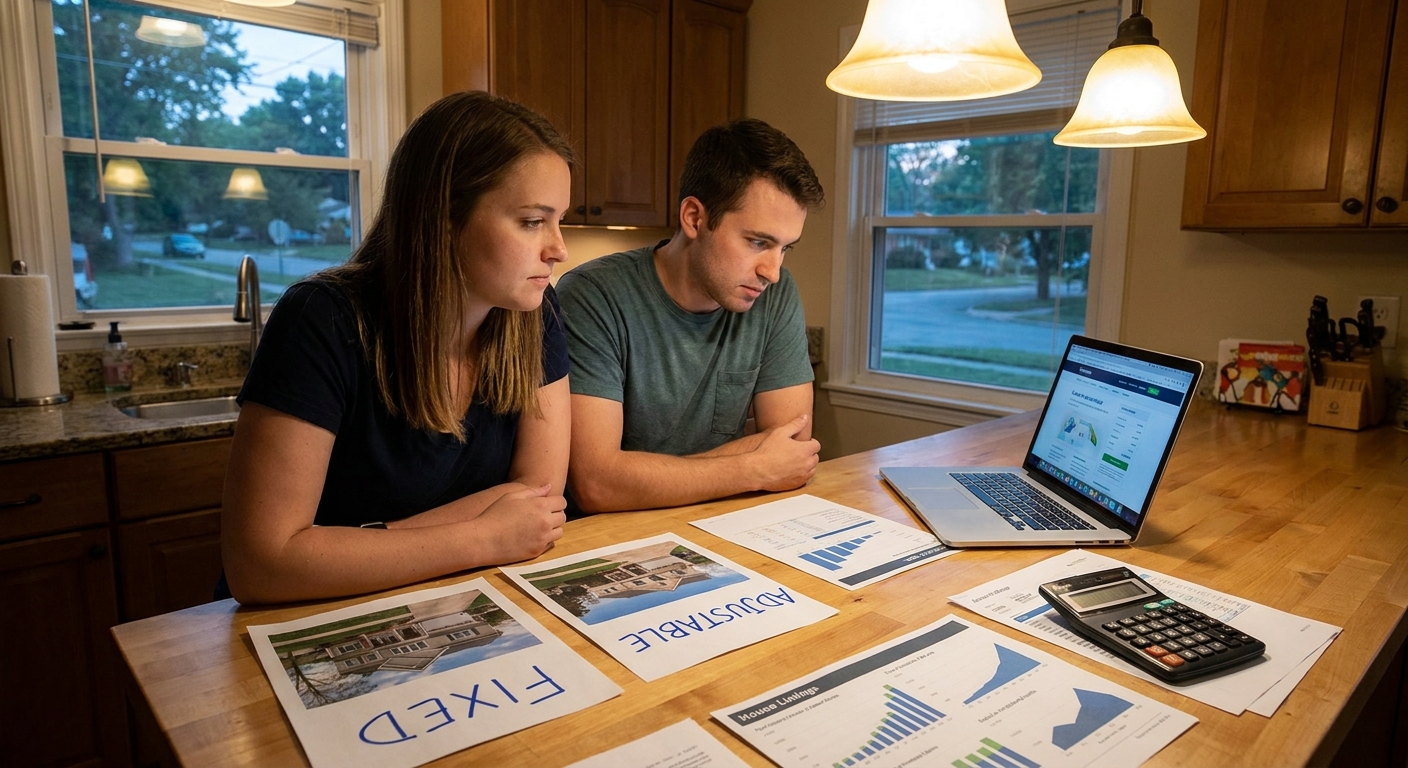
Buying your first home is a major financial decision. The mortgage you choose will shape your budget for years, so it pays to understand each step with clear numbers, not just rules of thumb. This guide walks through the process from setting a realistic budget to signing at the closing table.
Introduction
Step 1: Define What You Can Afford
The 28/36 Rule (And Its Limits)
Lenders often use the 28/36 rule:
- Housing ratio (front-end): Monthly housing costs (principal, interest, property tax, homeowners insurance, HOA dues) ≤ 28% of gross monthly income.
- Debt ratio (back-end): Monthly housing costs plus other debts (car loans, credit cards, student loans) ≤ 36–43% of gross income, depending on loan type.
Example – Income-Based Budget
- Gross annual income (household): $96,000
- Gross monthly income: 96,000 / 12 = $8,000
Using 28% for housing:
- 0.28 × $8,000 = $2,240 maximum monthly housing payment.
Assume:
- Property tax: $400/month
- Homeowners insurance: $90/month
- HOA: $70/month
Total non-mortgage housing costs: $560/month
Maximum principal + interest (P&I):
- $2,240 − $560 = $1,680/month for the mortgage payment itself.
This P&I limit will drive your maximum loan size.
Step 2: Understand Mortgage Types
Fixed-Rate Mortgage
- Rate stays the same for the entire term (e.g., 30 years).
- Monthly payment is stable and predictable.
Adjustable-Rate Mortgage (ARM)
- Introductory fixed period, then rate adjusts at set intervals.
- Example: 5/1 ARM – fixed for 5 years, then adjusts annually.
- Usually starts with a lower rate but can rise later.
FHA, Conventional, VA & USDA
- Conventional: Not insured by the government. Typical minimum down payment 3–5%, best terms often require higher credit scores.
- FHA: Government-insured. Down payment as low as 3.5%, more flexible on credit but with upfront and monthly mortgage insurance.
- VA: For eligible veterans and service members. Often 0% down, no monthly mortgage insurance.
- USDA: For eligible rural areas, often 0% down, income and location limits.
Step 3: Run the Numbers – A Complete Example
Assume you are eyeing a $420,000 home.
Option A: 5% Down Conventional Loan
- Purchase price: $420,000
- Down payment (5%): $21,000
- Loan amount: $399,000
- Interest rate: 6.25% (30-year fixed, example only)
- Term: 30 years
Monthly Principal & Interest
Using a standard mortgage formula or calculator:
- P&I ≈ $2,455/month
Estimated Taxes & Insurance
- Property tax: $5,400/year → $450/month
- Homeowners insurance: $1,200/year → $100/month
- HOA: $60/month
- Private Mortgage Insurance (PMI): assume 0.6% of loan/year →
- 0.006 × $399,000 = $2,394/year → $200/month (rounded)
Total Estimated Monthly Payment
- Principal & interest: $2,455
- Property tax: $450
- Insurance: $100
- HOA: $60
- PMI: $200
- Total ≈ $3,265/month
Compare this to the earlier affordability limit of $2,240/month. This home is above that guideline.
Option B: Lower Purchase Price & 10% Down
Target a $350,000 home.
- Purchase price: $350,000
- Down payment (10%): $35,000
- Loan amount: $315,000
- Interest rate: 6.25%, 30-year fixed
Monthly P&I
- P&I ≈ $1,938/month
Estimated Taxes & Insurance
- Property tax: $4,000/year → $333/month
- Insurance: $1,000/year → $83/month
- HOA: $50/month
- PMI: assume 0.4% of loan/year →
- 0.004 × $315,000 = $1,260/year → $105/month
Total monthly estimate:
- P&I: $1,938
- Taxes: $333
- Insurance: $83
- HOA: $50
- PMI: $105
- Total ≈ $2,509/month
Still above $2,240, but much closer. You might:
- Aim for a slightly lower price (e.g., $325,000), or
- Increase your down payment to reduce PMI and loan size, or
- Reassess whether 28% is conservative for your situation.
Step 4: Plan for Closing Costs
Closing costs typically run 2–5% of the purchase price.
For the $350,000 home:
- At 3%: 0.03 × 350,000 = $10,500
Typical items:
- Lender origination or discount points
- Appraisal fee
- Credit report fee
- Title insurance and settlement charges
- Recording fees and transfer taxes
- Prepaid interest, property tax escrows, and insurance
Cash Needed at Closing – Example
- Down payment: $35,000
- Closing costs (3%): $10,500
- Total cash: $45,500
Some buyers negotiate seller credits or use lender credits (higher interest rate, lower upfront costs). These can reduce cash due at closing but increase your monthly payment.
Step 5: Key Terms Explained Clearly
- Principal: The amount you borrow for your home.
- Interest: The cost of borrowing, expressed as an annual percentage rate (APR considers some fees too).
- Escrow: An account where your lender holds money to pay property taxes and insurance on your behalf.
- PMI (Private Mortgage Insurance): Insurance that protects the lender if you default, required when you put less than 20% down on many conventional loans.
- Amortization: The schedule of payments that gradually pay off your loan over time.
- Rate Lock: The lender’s guarantee of a specific interest rate for a set period (e.g., 30–60 days) while you complete the loan.
Step 6: Checklist for First-Time Buyers
Before You Apply
- [ ] Pull all three credit reports and correct errors.
- [ ] Pay down high-interest revolving debt if possible.
- [ ] Build an emergency fund (3–6 months of expenses).
- [ ] Estimate your realistic monthly housing budget.
When Comparing Lenders
- [ ] Request a Loan Estimate from at least 3 lenders.
- [ ] Compare APR, not just the interest rate.
- [ ] Check total closing costs and any prepayment penalties.
- [ ] Ask about rate locks and extension fees.
During the Home Search
- [ ] Get preapproved, not just prequalified.
- [ ] Understand local taxes and HOA rules.
- [ ] Run monthly payment scenarios for each home you consider.
Before Closing
- [ ] Review the Closing Disclosure and compare it to your Loan Estimate.
- [ ] Confirm how much cash you must bring to closing and in what form.
- [ ] Verify your first payment date and how to set up autopay.
Common Mistakes to Avoid
- Focusing only on the purchase price and ignoring taxes, insurance, HOA, and maintenance.
- Assuming you must borrow the maximum a lender approves; their number may be higher than what is comfortable for you.
- Skipping an emergency fund to maximize your down payment, leaving you exposed to surprise expenses.
- Not shopping lenders, accepting the first rate and fee structure presented.
- Ignoring total interest over time when choosing between rates and points.
Final Thoughts
Mortgages are long-term commitments, but they are also predictable tools when you understand the moving parts. Start from your own budget, compare several options side by side, and focus on the full monthly payment and total cash required—not just the headline rate. That approach will help you choose a mortgage that supports, rather than strains, your broader financial life.